
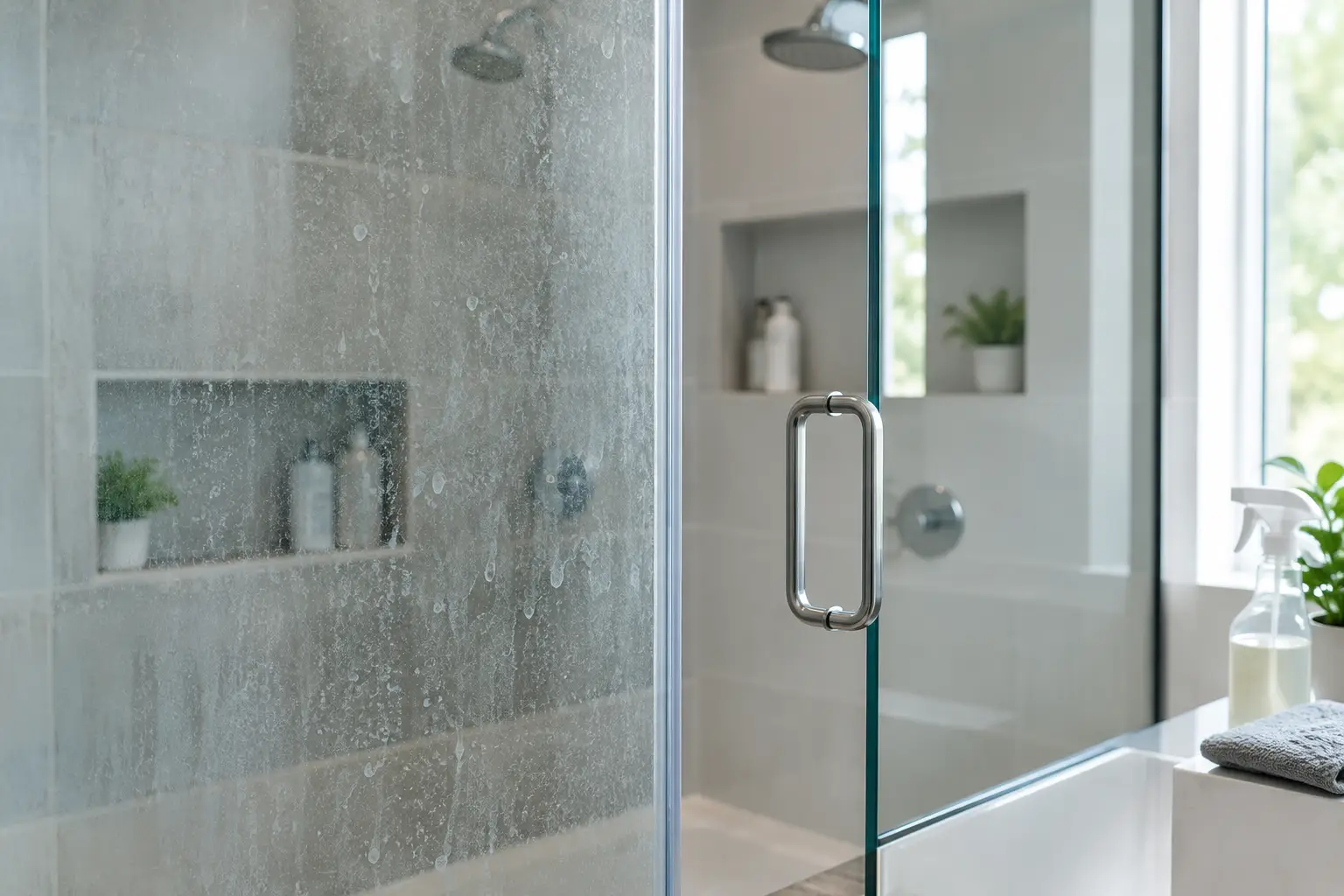
A shower door can look permanently marked long before it is actually dirty. What begins as a few white water spots often becomes a cloudy film that resists ordinary cleaning, dulls the glass, and makes a new bathroom feel neglected. Understanding why shower doors stain changes the maintenance conversation from repeated scrubbing to controlling the conditions that cause buildup in the first place.
The issue is rarely one substance alone. Hard-water minerals, soap ingredients, body oils, cleaning-product residue, and repeated wet-dry cycles can combine on the glass. Over time, some deposits sit on the surface while others contribute to chemical changes that make the glass harder to restore.
Why shower doors stain: three forces at work
Hard water leaves mineral deposits
Hard water is the most familiar cause of shower-door staining. It contains dissolved minerals, commonly calcium and magnesium. When shower water dries on glass, the water evaporates but the minerals remain. The result may be white spots, chalky streaks, or a hazy layer that becomes more visible after each use.
The rate of buildup depends on local water quality, how often the shower is used, ventilation, and how long droplets remain on the door. A busy household with mineral-heavy water can see visible spotting within days. In commercial hospitality or multifamily settings, frequent use makes the maintenance burden even more pronounced.
Mineral deposits are not always easy to remove with a general-purpose bathroom cleaner. Once layers accumulate, cleaning can require more dwell time, repeated applications, and careful mechanical action. That adds labor while increasing the risk of scratching surrounding finishes or leaving cleaning residue behind.
Soap scum creates a sticky film
Soap scum is different from a simple water spot. Traditional bar soaps and many body-care products contain fats, oils, surfactants, and conditioners. These ingredients can react with minerals in hard water and form a gray, waxy film on shower glass.
That film acts as a landing surface for more debris. Minerals adhere more easily, oils collect, and the door begins to look dull rather than merely spotted. Even clear liquid body washes can leave residues, particularly when products contain moisturizing ingredients. The stain is therefore often a mixture of mineral scale and organic residue, not a single contaminant with a single cleaning solution.
Repeated exposure can affect the glass surface
Glass is often described as nonporous, and it is far less absorbent than many building materials. However, untreated glass is not invulnerable. At a microscopic level, its surface can develop irregularities from constant exposure to water, minerals, alkaline residues, and cleaning chemicals.
When mineral-rich water is allowed to sit and dry repeatedly, deposits can become increasingly anchored to the surface. In more advanced cases, chemical attack can contribute to etching or surface degradation. This is why a door may remain cloudy even after visible scale has been removed. The issue is no longer only what is sitting on the glass – it may be the condition of the glass itself.
That distinction matters for homeowners and for shower-door professionals. A surface deposit may respond to an appropriate restoration process. Etched or damaged glass may improve, but it cannot always be returned to a factory-new appearance through routine cleaning alone.
Why some shower doors stain faster than others
Two doors installed in similar bathrooms can age very differently. Water chemistry is a major variable, but it is not the only one. Door design, user habits, ventilation, and the original surface condition all influence the result.
Frameless doors often show staining more clearly because there is a broad, uninterrupted field of glass. Dark tile, high-contrast lighting, and large-format showers make spots especially visible. A door that is never squeegeed and receives limited airflow after use will retain water longer, increasing the time available for minerals and soap residue to dry onto the surface.
Cleaning habits also matter. Harsh abrasives can create fine scratches that trap residue and scatter light, making glass appear hazy. Some cleaners may remove one form of buildup while leaving a film of their own. Acidic descalers can be effective on mineral deposits, but they must be selected and used carefully around metal hardware, stone, tile grout, and other adjacent materials.
For fabricators and dealers, this variability is a practical reason to position shower glass as a surface system rather than a commodity panel. The long-term customer experience is shaped by the glass, the protective treatment, the maintenance guidance, and the products used after installation.
Prevention works better than aggressive cleaning
The most efficient approach is to reduce water contact time and prevent residue from establishing a foothold. A quick squeegee after showering is still one of the simplest maintenance steps available. It removes much of the water before evaporation leaves minerals behind.
Good ventilation supports the same goal. Running an exhaust fan during and after a shower lowers humidity and helps the enclosure dry more completely. Wiping the lower edge of the door and the areas near hardware is useful because water tends to collect there.
Cleaning should be regular but measured. A mild, residue-conscious cleaner used consistently is usually more effective than waiting until thick scale develops and then attacking the door with abrasive pads or aggressive chemicals. The right frequency depends on water hardness and shower usage. In a hard-water area, weekly maintenance may be realistic; in softer-water locations, less frequent cleaning may be enough.
Hydrophobic protection changes the maintenance equation
A quality hydrophobic coating is designed to alter how water behaves on a silica-based surface. Rather than spreading and clinging as readily, water tends to bead and release more easily. This can reduce the amount of water left behind after a shower and make it harder for mineral deposits and soap scum to bond to the glass.
The benefit is not that a treated shower door never needs cleaning. Any surface exposed to personal-care products, hard water, and daily use still requires maintenance. The performance advantage is reduced cleaning effort, fewer stubborn spots, and a clearer surface over time when the door is maintained as directed.
For the glass industry, that translates into a stronger product story. A protective coating can differentiate a shower-door package, support premium positioning, reduce future service concerns, and give customers a more credible path to preserving their investment. For property managers and hospitality operators, easier-cleaning glass can also mean less labor spent on repeated restoration of heavily used enclosures.
Diamon-Fusion® is one example of a patented hydrophobic coating platform engineered to protect glass and other silica-based surfaces by repelling water and reducing the adhesion of common contaminants. The most effective results come from pairing surface protection with correct application, compatible aftercare products, and clear end-user guidance.
When cleaning is no longer enough
A door may need restoration when standard cleaning no longer changes its appearance, when the glass feels rough after cleaning, or when haze remains visible from multiple angles. Before replacing the door, assess whether the issue is removable mineral scale, soap-film accumulation, coating wear, scratches, or etched glass.
Professional restoration products and processes can address many forms of buildup without the unnecessary cost of replacement. However, results depend on the severity and type of damage. Deep scratches and advanced corrosion are not simply cleaning problems. Setting that expectation early protects both the customer relationship and the value of the installed product.
For a newly installed door, the best time to establish a maintenance plan is immediately – before hard-water deposits become a visible complaint. A few minutes of routine care, supported by the right surface protection, can preserve the clear, high-value appearance that made the shower enclosure worth choosing.